Wednesday, June 29, 2011

Grace Kelly - The Barefoot Princess Next Door


Grace outside her family's Ocean City home at 26th Street in Ocean City.

Vision of Grace
(This article first appeared in Atlantic City Magazine, January 1999)

Grace Kelly grew up at the Jersey Shore. The people who remember her as the kid next door recall her rise to Hollywood stardom, then royalty.

The Princess Next Door – Grace Kelly, screen actress and royal princess, summered at the Jersey Shore, where she is remembered as the girl next door.

By William Kelly

The Princess Next Door

Grace Kelly was a princess of our very own, who spent most ever summer vacation of her life on the Ocean City beach.

She was a princess who died suddenly in a tragic automobile accident in France, causing the world to stop and reflect on the life of the beautiful women who came from humble roots, married royalty, became a patron of charities, and was popular with ordinary people.

Princess Grace of Monaco, formerly Grace Kelly of Philadelphia and Ocean City, died nearly 15 years ago to the day before the death of Princess Diana. The death of Diana brought a sense of déjà vu to many people who knew Grace, sparking memories of the actress and Princess who her Ocean City neighbors knew as the barefoot girl next door.

“As in their death, their lives took similar paths,” noted Julie Knipe Brown in an article that appeared in The Philadelphia Daily News at the time of Diana’s death:

“Both young, shy and strikingly beautiful, they were swept off their feet by prince charmings, married in lavish ceremonies, and dogged by gossip columnists and photographers the world over. They produced heirs to thrones, played host to worthwhile charities, and spawned fashion trends that served as benchmarks of elegance and grace. One renounced Hollywood to marry a prince. The other eventually renounced her prince and fell in love with a Hollywood prince charming. Neither lived happily ever after. Diana’s marriage ended in scandal and divorce, while biographers often portrayed Grace as a drinker, distanced from her husband. Somehow, frailty made us love them even more, as tragic and heroic figures.”

Of the dozens of books that have been published about Grace Kelly, few ring true, especially references concerning her life at the Jersey Shore. One “interpretive biography” claims she spent her summers in “…Margate, the nicest section of the town.” After publication of one sensationalist pseudo-biography, Grace’s cousin John Lehman, former Secretary of the Navy, noted, “If any fraction of what that book described had taken place, do you think that the press would have let that gone unreported? Do you think it is only a coincidence that ever person that he accuses her of having an affair with is now dead?”

Those who knew Grace Kelly in Ocean City, even those merely acquainted with her, remember her as a beautiful, talented women with ambition, who prized her family and cherished Ocean City’s hometown family spirit.

Like many Philadelphia families, the Kellys vacationed in Ocean City, eventually buying property and building a house that they returned to ever spring. The Kellys were famous, however, before Grace became and actress and princess. The family tree is firmly rooted in her father, John B. Kelly, Sr., who was born near the Schuylkill River in Philadelphia to immigrant Irish parents.

John B. Kelly left school to work in the building trade and eventually had a hand in constructing practically every major skyscraper in center city Philadelphia during his lifetime, beginning with the John Wannamaker department store when he was a teenager. Growing up on the Schuylkill, home of Boathouse Row, he became a member of a rowing club and went on to win two gold medals in the Olympics and both the singles and doubles rowing championships in 1920 and in 1924. Yet Kelly was not permitted to compete in the Diamond Sculls at Henley, England. The competition was only open to so-called “gentlemen,” and as a bricklayer, who worked with his hands, he was considered a common worker, and not a “gentleman.”

At the christening of his son, he vowed that John B. Kell, Jr. (Jack, aka ‘Kell”) would avenge the slight, and he groomed him to win at Henley from a very early age.

Establishing his own construction company, with the slogan, “Kelly For Brickwork,” Kelly prospered. But the Philadelphia Main Line blue blood society of “old money” shunned the new wealth of blue-collar Kellys, who lived on Henry Avenue in East Falls.

In the summer, Kelly the family to Ocean City, which later became known as “America’s greatest family resort,” where he rented a seasonal house for few years before he built a brick house in the then popular Spanish Revival style on the northwest corner of 26th and Wesley Avenue in 1929, the year Grace was born.

As it was just across the street from the ocean, the house was a retreat from active days in the water and on the beach. Family friend Marie Magee recalled, “little as she was, (Grace) would go out in that ocean and swim through the huge waves.”

Both John B. Sr. and Jr. were supporters of the Ocean City Lifeguard Association and often took the lifeguard boats out beyond the breakers, where they rowed from one end of the island to the other, preparing for the day Jack would row at Henley. Eventually, he did go to Henley and won the Diamond Sculls championship that was denied he father.

“No American family has given the nation a legend more honorable than this,” wrote John McCall, an Ocean City neighbor, “we are American gentlemen because of that.”

As the boys became gentlemen in boats on the water, it was also in Ocean City where the girls grew up to become ladies. As biographer Sarah Bradford described it, “At Ocean City there would be nights on the boardwalk…The Moorlyn Cinema, where Grace often used to go, is still there, a period piece with a facade designed to look like the noise of a 1950s automobile. There were no bars, because Ocean City was, and is, dry, and Grace and her friends would go to Matt’s to have hamburgers and coke after the movies and dance to the jukebox barefoot on the boardwalk so they got splinters in their feet.”

In their early teens, Grace and her friends Carol Macallister and Maree Rambo got jobs as waitresses at the Chatterbox restaurant on 9th Street and Central Avenue (which is also still there). That summer Grace dressed like a beauty queen and waved to the crowd from the Chatterbox float in the annual boardwalk parade, but their waitress jobs were taken away when Maree Ramob’s mother learned they were going to work at night, past curfew, and they still weren’t allowed to date.

The Kelly family grew and prospered. In addition to older brother Jack, Grace had older sister Peggy and younger sister Lizanne.

While his family played on the beach, Grace’s father could often be found on the Northfield Links of the Atlantic City Country Club, where he met Frank “Hap” Farley and James “Sonny” Fraser. With Farley, who took over as political boss when Enoch “Nucky” Johnson went to jail, and Fraser, a state legislator, Kelly became part of the syndicate that bought the Atlantic City Country Club during World War II.

But they had bigger ambitions – bring legal gambling to Atlantic County by establishing the Atlantic City Race Track, which was built by Kelly’s construction company. The Track opened on July 22, 1946, and quickly became the most popular attraction at the Jersey Shore, routinely drawing tens of thousands of people for every meet, including President Eisenhower and celebrities like Bob Hope, Frank Sinatra, Jerry Lewis and Dean Martin.

But the beach was still the place for the Kelly family during the day. “Each summer there was Ma Kelly’s Labor Day party and open air barbeque in Ocean City,” wrote Sarah Bradford. “Parents, children, everybody was invited.” As friend Alice Waters recalled, “There were games, we had watermelon spitting contests and we had hide-and-seek, and we sang and roasted marshmallows. It was something I grew up with and loved.”

Mrs. (Margaret) Kelly, who attended Temple University and was a physical education instructor at the University of Pennsylvania, was as much into the sports scene as her husband and children. She ran the house and the beach.

Jim Campbell, who used to rent beach chairs for Bert’s Beach Service at the 26th street beach recalls, “Every morning the first thing I did was set up some chairs and umbrellas for Mrs. Kelly. She would come out to the porch and wave, and later bring me something cold to drink, and at the end of the day she would give me a dollar tip.”

When dinner was ready, Mrs. Kelly rang a bell on the porch that would signal everyone to come in for the evening meal.

Grace’s sister Peggy Kelly Conlan, recalled for Ocean City historian Tim Cain, “My brother was always their mascot, so we always knew the lifeguards. There were very few people on our beach in the early days…”

One lifeguard, William Ashmead said, “One year I had the distinction of working for about three weeks in the early part of the season at 26th Street. The Kelly family (was) very nice, great to the lifeguards. Grace would bring us down sandwiches and milk and sodas…Grace was probably about 16 at the time. Who knew then that she would become that famous?”

All the boys on the beach remember Grace, especially when she became old enough to date.

“The beach was a very big part of the routine here,” recalls Grace’s sister Liz LeVine. Swimming, walking along the beach and boardwalk, riding bikes and going to 14th Street – that was the most popular beach at the time.”

“I met her on the 14th Street beach the year she got out of Stevens School [a high school in the Germantown section of Philadelphia] recalls Dick Boccelli. “My father knew their family from the same neighborhood in Philly, and I knew her brother Jack, who I played basketball with down at the 6th Street courts. But it was an old chum of mine who introduced me to her on the beach, and we started dating.”

“I took her out in my father’s 47 Lincoln, so her father thought I had money,” says Boccelli, “but she knew and to her, it didn’t matter.” Boccelli recalls taking her to shows in Atlantic City and ending up at Vaughn Comfort’s club on the Somers Point Circle, where they were entertained by singing waiters.

“Grace had a great personality…a good sense of humor, was bright, sharp, fun to be with, and there were no pretensions about her,” says Boccelli, who played football at West Chester College at the time. “The whole family is big into sports and when she came to one of my football games I had a friend of mine sit with her in the stands so nobody would hit up on her. My mistake was that after we were going out for about six months, I introduced her to the most handsome man at West Chester, and that was it for me.”

“She wanted to be an actress,” recalls Boccelli. “I went up to New York and saw her in her first role [1949 Broadway production of The Father] and she did a wonderful job. She was picked out, not because of who she was, but because she was that good and stood out. To me, she was a natural,” adds Boccelli, “and when they gave her that phony accent, they missed the boat, but that’s Hollywood.”

In the summer, the Atlantic City Race Track was known as the “Hollywood by the Sea,” and Grace was the vivacious daughter of one of the owners.

“We all knew Grace,” recalls Henry Block, a former jockey at the track. “She would sit in the owner’s box, but we’d see her around the town, and she was always up for something. One day I ran into her at the Circle Diner in Somers Point, and since we were both heading out to the track, she said, “do you want to race?’”

According to Block, she drove a station wagon down Shore Road, cut over through Bargaintown, and beat him to the track.

Others remember her going with the crowd at night to Bay Shores and Tony Marts in Somers Point, where she would drink and dance to the rock & roll bands. “She was a beautiful person and a beautiful dancer,” recalls Carol Macallister, who attended Stevens School with Grace. “I could never understand why Hollywood didn’t play up her dancing.”

Once she became a movie star, she began dating men she met in Hollywood and New York. As one biographer put it, “Of course it was never easy to be Grace Kelly’s boyfriend, but when Grace brought Oleg Cassini home to meet her folks, the conversation at the dinner table was uneasy, as both John B., and her brother Jack did not take a shine to the European Casanova…Then, while attending the Canes Film Festival on the South of France, she was persuaded to take a photo shoot at the castle home of Prince Rainier of Monaco at nearby Monte Carlo.”

Grace’s marriage to Prince Rainier Grimaldi III of Monaco was the international social event of the 1950s. Rainier came to Ocean City on more than one occasion, visited the Kelly family at the beach, and sat in the owner’s box at the racetrack. Scruitized by Grace’s father, Rainier was acceptable, even if a little stuffy compared to the carefree Kellys.

Her career as an actress was over, however, as she would devote herself full time to her family and never return to the silver screen.

Of course, the wedding was not in Philadelphia, nor in Ocean City, but at Monaco’s Cathedral of St. Nicholas. Rainier arranged for an ocean liner to bring the entire Kelly clan to Mone Carlo – a voyage, ceremony, and party that became the most sensational news event in the world.

Even after she attained Royal Status, Her Serene Highness Princess Grace of Monaco returned to Ocean City on a regular basis with children Caroline, Albert and Stephanie, usually around Labor Day, to attend the annual family reunion and beach barbeque.

“Ocean City was an important part of Grace’s life,” wrote Sarah Bradford. “She would bring her own Grimaldi children to the Shore every year as if to remind them that this solid Middle America resort with its healthy pleasures was as much art of their heritage as the glittering life of the Cote d’ Azur…it ws part of Grace’s plan that the =children should remain aware of their American heritage, and they would spend part of every summer with their Kelly cousins at Ocean City.”

By that time, the Kelly clan had outgrown the original house, and in 1960, the year John B. Sr. died, a new home was built on the beach across the street from the first house. Capping a successful life for Grace’s father, it was naturally made of brick.

Neighbor Kate Field said, “I don’t think of them as royalty,” and recalled one afternoon when the young Stephanie and Albert were riding skateboards in the house up and down the hall when her grand-mother said, ‘Put the skateboard away.’ And that was it for the skateboard.”

Grace enjoyed returning to Ocean City because it was a place where she could be herself, without being bothered by the press or the public. As one of her bridesmaids, Judith B. Quine, explained, “Grace relaxed…at Ocean City…Together with her brother (Jack) and sister-in-law Mary, and with her two sisters and their husbands, they took the family’s younger se for walks on the beach and boardwalk, collecting souvenirs and seashells as they ambled. There were the inevitable barbecues, potato sack races, horseshoe crab games, and other competitions, which reminded Grace of every childhood summer she had spent with her family at the shore.”

Cousin John Lehman, who keeps the family Labor Day beach tradition going, said, “We have surfing contests, bake-offs, and other competitions at a kind of a picnic. Grace used to come and officiate the competitions…She never lost sight of or forgot the values of ‘the family first.’ And that is so rare, since so often you find people who succeed, and totally sacrifice their family, and she didn’t.”

On Lehman’s birthday, September 14, 1982, the first season she did not make it to the family reunion in Ocean City, Grace Kelly died after her car swerved off a road and went over a cliff in the south of France, an accident her daughter, Stephanie, miraculously survived.

Ocean City neighbor Kate Field recalled hearing about it on the radio. “I’ll never forget hearing about it because I was taking laundry down and I went to reach for a clothespin, and I couldn’t touch it,” she told Tim Cain. “That’s how paralyzed I as. I went to Lizanne’s house, and by the time I got there Lizanne was on the phone and I wrapped my arms around her and she said, ‘My God, I can’t believe what we’re hearing.’ All Lizanne kept saying was, ‘Isn’t it terrible, isn’t it terrible!’”

“The phone rang and then they got the official word,” Field recalled, “and I don’t think it was five minutes…we looked out the picture window and on the sand dunes there were TV cameramen out there.” Lizanne’s husband Don LeVine remembered saying, “How can they do this to us now?”

“I think the Kellys were role models,” said Field. “I think they meant stability. There were many times in their lives when they met with difficulties, and they showed that you just have to hang in there and pull it together and make it through.”

Grace’s sister Peggy and Ma Kelly have since died Daughter Caroline was in Ocean City when her husband was killed while participating in a speed boat race. In 1985 brother Jack suffered a heart attack while jogging in Philadelphia. Within hours, only a few blocks away, Peggy’s husband also died of a heart attack. East River Drive, which runs along the Schuylkill River, was renamed Kelly Drive in the Kelly family’s honor.

Grace is also honored by the Princess Grace Foundation, which awards scholarships to artists, dancers, actors, and actresses every year at a gala ball in New York’s Waldorf Astoria. Liz LeVine’s son is on the Board of Directors that chooses the scholarship winners annually. LeVine and her husband now live at the house on the 26th Street beach.

SHORTLY AFTER PRINCESS DIANA DIED, A NEIGHBOR OF mine bought Flannery O’Conner’s Irish Short Stories at a garage sale for 50 cents, and opened the cover, where there was an inscription signed by Grace Kelly. As a member of the “other” Kelly family that lives on Wesley Avenue in Ocean City, I was shown the inscription and asked to authenticate it. I called Liz LeVine to ask if she would authenticate the signature as her sister’s handwriting.

“Come on over,’ she said. So I rode a bike down the street, rang the doorbell, and was quite surprised when a young women answered the door. “Hello, I’m Grace, Grace LeVine, come on in.”

Liz Levine looked at the inscription and immediately noted that it was not her sister’s signature. She closed the book and sighed. “The death of Di has certainly stirred a lot of memories of Grace,” she said. “We’re getting phone calls from people we haven’t heard form in years. There are a lot of strange similarities in their lives, though Grace was 52, and not as young as Di. It doesn’t seem that long, but it’s been almost exactly 15 years since Grace died, so a lot of people have been remembering things and calling.”

And their paths did cross, she said. Grace attended Princess Di’s wedding, and Diana went to Grace’s funeral as the official representative of the British royal family.

“Grace was not a prima donna,” her younger sister said. “Certainly did not dress like an actress or a princess, at least not while she was in Ocean City. She’d come in, kick off her shoes, and run around barefoot, just like the rest of us.”

Just like the rest of us. And that’s how her Ocean City neighbors remember Grace, the barefoot girl next door.


This article first appeared in Atlantic City Magazine – January 1999

[William Kelly can be reached at billkelly3@gmail.com ]

Tuesday, June 28, 2011

The American Prince - Albert in Ocean City, N.J.


PRINCE ALBERT OF MONACO

As Prince Albert prepares to get married in Monaco this weekend, I thought it appropriate to point out that his mother was an American who spent ever summer of her life in Ocean City, NJ USA, except her last one.

She was literally the Princess next door [see: Atlantic City Magazine article] who was born in 1929, the year that her father built the Spanish Revival style brick home that still stands on the northwest corner of 26th street and Wesley Avenue in Ocean City. Her brother was a life guard and she worked as a waitress at the Chatterbox and hanged out with her sisters and friends at the 4th street beach. She celebrated her sweet 16 birthday party at the Seaview Country Club, and was sophisticated enough to get served at the bars in Somers Point before she was 21. She loved to act and danced at Bay Shores and Tony Marts.

Grace Kelly left town for Broadway and then Hollywood, but always came back to Ocean City every summer to spend time with her family. One summer she brought a guest with her - Prince Rainier III of Monaco, who she met while filming To Catch a Thief in Monte Carlo.

She had previously brought home guys who her father John B. and brother "Kell," both Olympic rowing champions, thought the less of, and just didn't cut muster with them.

But Rainier was a "Man's Man" who John B. took a liking to, especially after he showed his knowledge of horses at the Atlantic City Race course.

Grace and Rainier were married in the "wedding of the century" that has never been eclipsed, though challenged by Princess Di and more recently by Prince William.

John B. leased an ocean liner for his family and friends to sail to Monaco for the affair, and a few years later, as Margaret, his American grandmother called him, "Bonny" Prince Albert of Monaco was born in 1958, and as the BBC reported at the time: “A celebratory 101-gun salute has been fired in Monaco after Princess Grace - formerly film star Grace Kelly - gave birth to a son.In spite of elaborate arrangements made for announcing the birth, the world learnt about the baby's arrival when a woman at a palace window shouted to waiting journalists: ;It's a boy, it's a boy.'"

"The 8lb 11oz baby who was born at just before 1100 local time is to be named Albert Alexandre Louis Pierre. He will be known as Prince Albert," and noted that,"The baby takes automatic precedence over his one-year-old sister, Princess Caroline. The young princess appeared on a palace balcony in the arms of her father, Prince Rainier III, shortly after her brother was born. Prince Rainier later broadcast an address to the nation announcing the Crown Prince's birth. Speaking to journalists, the princess' mother, Margaret Kelly said both her daughter and the baby were doing well. ‘It is a bonny, bonny prince,’ Mrs Kelly said.”

Officially noting the fact that, "Prince Albert was born March 14, 1958 to HSH Princess Grace (1929-1982) and HSH Prince Rainier III of Monaco. The day following Albert’s birth was declared a public holiday; flags and flowers were everywhere," and explaining the significance of the event because, "Albert’s birth ensured that Monaco remained independent of France for another generation. Under a treaty signed by both countries in 1918, if Monaco had no heir, it would become subject to French laws."

Although he was of European royalty, his mother took Albert and his sisters to Ocean City with her most summers to ensure that they experienced the American scene, and understood her mother's blue collar Irish background.

Although Grace's younger sister Lizanne missed the wedding because she was pregnant with her daughter, named Grace, she ended up babysitting Albert when he visited Ocean City with his mother. Lizanne once recalled to me that Albert developed a distinctly American streak in him, and his mother would have to scold him for riding his skateboard in the house.

By this time John B. had built another brick beach house across the street from the Spanish Revival one, and both John B. and Grace's brother Jack, or "Kell," as they called him, rowed with the lifeguards and spent a lot of time at the Atlantic City Race Track, which John B. had built and where Lizanne's husband Don worked as a steward.

Spending part of each summer with his mother in Ocean City, Albert and his sisters played ball on the beach with the lifeguards and ate at Mack & Mancos tomato pie on the boardwalk. When dinner was ready mother Margaret would ring the ship's bell that hung by the back door and everyone would come in off the beach. Margaret would later pass away quietly in the Linwood Convalescent Center.

In the mid-Sixties, I was their neighbor, and remember the large Kelly family frequently patronizing the 22nd Street Restaurant where I worked as a busboy. The restaurant was owned by Mr. Patradus, a friend of my father who was from Greece, and his restaurant was just around the corner from the Kelly house. The one thing about them was they weren't treated special and didn't seem to expect it. They were just another family on vacation at the Shore.

As the news report notes, "From all accounts, Albert had a happy childhood much as any other child. He attended school at the Lycee Albert I of Monaco where he received his baccalaureate diplomawith distinction in 1976. Then, from 1977 to 1981, he studied at Amherst College in Massachusetts and graduated on May 30, 1981 with a Bachelor of Arts in Political Science. Following the time spent at Amherst, Prince Albert served in the French Navy as second grade sub-lieutenant, on board the helicopter-carrier 'Jeanne d'Arc'."

Albert not only was educated at an American college, he also participated in the Olympics, following the lead of his grandfather John B. and uncle "Kel," both of whom won Olympic medals in sculling. "Throughout his life, Albert participated in many sports, including soccer, handball, judo, swimming, tennis, sailing, skiing, squash, fencing and rowing and in several Winter Olympic Games as a member on the Monaco bobsled team."

Their cousin, former Navy Secretary John Lehman, still maintains the family's Ocean City traditions, and recalled how they all used to play very competitively in games on the beach. I'm pretty sure that John Lehman will be at the wedding, representing the Kelly side of the family, and make sure that the American streak is honorably exhibited during the proceedings.

Besides cleaning up his family's dinner plates as the busboy at the 22nd Street Restaurant, I had the honor of meeting Albert on two occasions, the first in 1983, at the Ocean City memorial service for his mother at the Ocean City Music Pier, and then again in 1988 in Australia.

After the memorial service at the Music Pier, I was invited to a second reception at the old red brick school house on Wesley Avenue in Ocean City, which has since been demolished to make room for a dog park. At the time however, it was being used as an Arts Center, and was right down the street from where I lived at 819 Wesley, and about twenty blocks from the Kelly beach house at 26th street, which was also on Wesley Avenue.

On the day Grace Kelly died, since our name was Kelly and we lived on the same street, we got a lot of wayward phone calls meant for them. The answering machine at my house had a dozen seemingly important messages from all around the world that my brother Leo dutifully transcribed and then delivered to the home of the Other Kellys on Wesley Avenue. We were the Camden Kellys and they were the Philly Kellys.

At the reception at the Arts Center, local realtor John Carey, another big supporter of the Ocean City Lifeguards, presented Albert with a plaque that he had handmade, while I drifted off into the corner with "Kell," Grace's brother.

While we sipped wine and dabbled in some cheese bits, I asked Kell to tell me his Olympic story so I would hear it right from the horse's mouth and not second hand, and he obliged. Back in the 1920s, Kell explained, his father, the late John B. was a sculler, as were most of the boys who grew up along the Schuylkill River near Conshohocken. His father John B. won the Olympic Gold Medals in singles and doubles but was not permitted to enter the elite British Henley races because he was a bricklayer and worked with his hands, and the Henley bylaws only permitted proper gentlemen to compete.

Well, from that time on, John B. raised his son to be a rower, and row he did. Kell not only rowed on the Schuylkill with the crews from Boathouse Row, but also with the lifeguards off the Ocean City beach. Kell said he was primed, his whole life from birth, to win the Henley. Although he only won the Bronze medal in the Olympics, he went to Henley to achieve what the British wouldn't allow his father to do, and that he did. Upon winning the Henley race on the Thames, he returned home to a hero's welcome.

While Kell was recounting the story, Albert came over and John B. introduced me to him and we talked briefly. Kell however, didn't last much longer, and he too died while jogging along East River Drive, now Kelly Drive in Philadelphia.

I thought it amusing however, that when Prince Rainier built some new ritzy apartment buildings on the hills overlooking the harbor at Monte Carlo, Grace was given the honor of naming them, and she chose to call them Schuylkill and Conshohocken, after the river and Philly neighborhood near where she grew up in East Falls.

A few years later, while I was in Freemantle, Australia for the America's Cup sailing regatta, Albert was the guest of honor at the America's Cup Ball, and we again crossed paths briefly on the dance floor. While I know he didn't remember me, I told him I was from Ocean City and his eyes lit up and he asked me to introduce him to Jimmy Buffet. Actually, the photo of me in a tux on this page was taken that night. The local Australians had a contest to see who would be Albert's date that night, but the spotlight was always on him and he couldn't let his American side out.

As the report continues, "Prince Albert has been preparing for the most import role of his life - that of future leader of Monaco. He attends cabinet meetings with Prince Rainier and heads Monaco’s delegation to the United Nations. Prince Albert also serves on several national and international committees, organizations and federations mostly related to athletic and humanitarian concerns. Prince Albert is also Vice-President of the Princess Grace-USA Foundation in honor of his mother who passed on September 14, 1982. He attends social and official occasions such as the yearly Red Cross Ball. As health problems continue to sideline Prince Rainier, Prince Albert finds himself more in the spotlight. Prince Albert has two siblings, an older sister, Princess Caroline and a younger sister, Princess Stephanie."

While Caroline and Stephanie have been pretty quiet of late, Albert has admitted fathering a child with a stewardess before his father passed, and has taken his responsibilities as a ruler of the municipality of Monaco seriously.

More recently, in early February, he hosted an emergency conference on the revolutionary crisis that is sweeping North Africa and the Middle East, recognizing its significance early and taking immediate measures to deal with it.

And now, following closely on the heels of Prince William, "Bonny" Prince Albert is getting married, much to the delight of the citizens of Monaco, who will undoubtedly throw a big party in his honor.

From my brief impressions of him, I'd say that Albert will not have as big affair as William, though I'm sure he'll consult with Willy before hand and there will be plenty of pomp and circumstance.

Prince Albert's wedding will certainly be a great event, and should include somethings that will represent and reflect his mother's influence and his American roots, though I don't think he will ride his skateboard down the isle.

Bill Kelly
billkelly3@gmail.com

Wednesday, June 22, 2011

George Savisky - 1948-49 Champion Eagle


1948 Champion Philadelphia Eagles football team included George Savisky


Ocean City’s George Savitsky

George Savitsky was one of my Ocean City neighbors, his daughter Lisa was my mailgirl.

I talked with Savitsky when he was honored at the annual Maxwell sports dinner in Philadelphia one year for being a four time college All-American and a two time Philadelphia Eagles champion lineman.

“I’m honored to be in such company,” he said from his Ocean City home before the dinner, where he was slated to sit at the head table with quarterback Randal Cunningham and former coach Art Shell.

Savitsky, originally from Camden, was named to All American teams each of his four years at Pann (44-47), he also played on two world championship Philadelphia Eagle teams (48-49) and lived in Ocean City for 30 years.

Besides being honored by the Maxwell Club, Savitsky was one of twelve players and three coaches inducted into the College Football Hall of Fame in New York.

“I was a two-way lineman in those years at Penn,” said Savitsky, “a year older than Chuck Bednarik.”

Bednarik, the last of the two way, offensive and defensive players, went on to play on the Eagles with Savitsky.

“They were the Steve Van Buren years,” he said, “with Tommy Thompson, the one-eyed quarterback who led us to the championships.”

“It’s nice to be remembered after all these years,” said Savitsky. “Gone, but not forgotten. But no one can accomplish things, alone, without team mates, family and friends.”

To be eligible for nomination to the College Football Hall of Fame a player must be out of college for ten years and must have been a first team All American at least one year during his college career. Among the other players inducted with Savitsky were wide receiver Fred Biletnikoff (Florida State), lineman Alex Karras (Iowa) and Heisman Trophy winners Pat Sullivan (Oklahoma) and Steve Owens (Auburn).

“They’re all younger guys,” Savitsky noted. “I’m about the oldest player among those elected, but that’s pretty good company.”

After playing with the Eagles, Savitsky became a dentist, explaining that they didn’t make the kind of money that current players earn, only getting $300 per game.

“I had to raise a family,” said Savitsky, “and I couldn’t do it playing football.”

Sunday, June 19, 2011

Me and Rod Serling - Enter The Twilight Zone


Rod Serling

Witness one Rod Serling – Standing alone, flesh, blood, muscle and mind. A frustrated actor turned writer, he stands forever in the nightmare of his own creation, pressed into service in the role of narrator for a weekly television drama – The Twilight Zone.

For those who watched and listened, he showed how thin a line separates that which we assume to be real and that which is a product of our own minds.

There is that hauntingly repetitious four-beat score that opens the show, as Serling, dressed conservatively in dark suit and tie, steps out of the shadows and stands in the starry night. With his hands clasped in front of him, he says in his distinctive voice, talking out of the side of his mouth:

“There is a fifth dimension beyond that which is known to man. It is a dimension as vast as space and timeless as infinity. It is the middle ground between light and shadow, between the pit of man’s fears and the summit of his knowledge. This is the dimension of imagination. It is also an area we call the Twilight Zone.”

Marc Scott Zicree, in his book The Twilight Zone Companion (Bantam, 1982) tells us that the original music for the show was composed by Bernard Herman, who also did such classic film scores as Citizen Kane, Psycho and The Day The Earth Stood Still. Zicree describes it as, “a subtle and lonely piece scored for strings, harp, flute and brass,” but that was replaced after on season “by the more familiar rhythmic theme by French avant-guarde composer Marius Consant.”

As for the name of the show, Serling said, “I thought I’d made it up, but I’ve since heard that there is an Air Force term relating to a moment when a plane is coming down on approach and the pilot cannot see the horizon, it’s called the twilight zone, but it’s an obscure term which I had not heard before.”

Since then the lexicon should show that the CIA psychologists used the term to denote the state of mind of subjects to whom they administered LSD.

But from now on the term “Twilight Zone” will forever be associated with Serling, who conceived the idea for the TV show and wrote many if not most of the scripts. He made the show unique, parlaying an award wining TV drama into the half-hour weekly program that didn’t have the continuity that plots and characters give sit-coms and soap operas.

When word got out that the show would be scary, Serling rejected the advances of agents representing various monster and robot actors who monopolized other sci-fi shows, politely telling them he had something else “in mind.”

And indeed, the Twilight Zone would stimulate endless nightmares, portraying ordinary people in frightening predicaments. But it made people think, and come back for more.

Serling’s contract only called for him to write 80% of the shows, and for Orson Wells to do the narration, but when Orson Wells required more money than they were allocated, and others just didn’t seem right, Serling volunteered to do the narration himself. While it turned out to be the most familiar and endearing part of the series, it was also Serling’s own personal nightmare, as he had stage fright.

The producers and director were at first skeptical of Serling himself doing the opening dialog, but then, as Serling put it, “They looked at me and said, ‘Hell, at least he’s articulate and speaks English, so let’s use him.’ Only my laundress knows how frightened I was.”

According to Zicree, “Serling had more problems adjusting to his on screen role than just stumbling over the occasional word.”

Director Lamont Johnson said, “Rod was a very nervous man before the camera. When he had to do lead in time he would go through absolute hell. He would sweat and sputter and go pale. He was terribly ill at ease in front of a camera.”

Like all successful TV programs, they last only as long as the scripts maintain a certain quality, and writing is what Serling did best.

Born Rodman Edward Serling on Christmas day 1924 in Syracuse, New York, Serling was the second son of Ester and Samuel Serling, his father a wholesale meat dealer.

Popular, outspoken and confident, Serling read pulp paperback novels and mimicked movie actors as a kid. He went in for dramatics in high school, and served as a paratrooper in the Philippines during World War II. After the service he attended Antioch College in Yellow Springs, Ohio, and started writing radio scripts and bad poetry.

His wife Carol, who published a Twilight Zone magazine that featured original short fiction, recalls that Rod’s writing habits got him up at dawn. After grabbing a cup of coffee, he would “dictate his scripts into a tape machine.” Often, if the weather was nice, he’d take the machine outside with him and sit by the pool.”

One friend noted, “He is the only person I knew who could get a tan and make money at the same time.”

After five seasons of the Twilight Zone, Serling hosted another TV weekly, The Night Gallery, which also developed short story themes.

Then, years after Serling’s death, they made The Twilight Zone movie, which adapted a few of the original shows to film. It partially succeeded, but the death of actor Vic Morrow and two children in its making put a stigma on the production.

While Serling wrote most of the Twilight Zone TV segments, only “It’s a Grand Life,” about a spoiled boy with supernatural powers, was written by Serling that is included in the film. “Nightmare at 20,000 Feet,” which originally stared William Shatner, was written by Richard Matheson, and first published in the Anthology “Alone By Night” (Ballentine, 1961), while “Kick the Can” was written by George Clayton Johnson.

Johnson once said, “On the Twilight Zone, there was an attempt to keep it literary, to keep it bright, to keep it good. No one in the show ever suggested that something would be good enough – although that’s common today in commercial television. Just to do it good enough. Quality control counted in the Twilight Zone.”

In his last published interview several months before his death, Serling said, “I just want them to remember me a hundred years from now. I don’t care that they’re not able to quote a single line that I’ve written. But just that they can say, ‘Oh, he was a writer,’ That’s sufficiently an honored position for me.”

In May, 1975, Serling suffered a mild heart attack while scheduled to give a lecture at a college in upstate New York, and had to have a coronary bypass operation.

When I read in the news papers that he was in the hospital, I sent him a small note, mentioning that I too had attended classes at Antioch College while a student at the University of Dayton, Ohio, and included a poem by William Bulter Yeats, from Supernatural Songs – The Four Ages of Man.

“He with body waged a fight, but body won, it walks upright.
Then he struggled with the heart, innocence and peace depart.
Then he struggled with the mind, his proud heart he left behind.
Now his war on God begins; at stroke of midnight, God shall win.”

A few days later, on June 28, 1975, after ten hours of open heart surgery, complications arose and Rod Serling died. I heard about it on television at home in Ocean City, and wondered if he ever got my note.

The next day I went out on the porch and took the mail from the mail box and was surprised to see one postmarked from upstate New York. The corner of the envelope said it was from Rod Serling.

I could hear the music from the Twilight Zone as I opened the envelop – Da da, da da, da, da, da da....

It was brief and to the point, typewritten, apparently dictated and signed, thanking me for the poem, and saying that he was really worse off than what the newspapers had let it out to be, and that he wouldn’t be working on any projects for awhile.

And now he’s stuck in that middle ground between light and shadow, and is remembered not as a writer, but as our host in his personal nightmare – the Twilight Zone.
Now whenever anything strange or unexpected happens, we hear the faint strains of that music, and quickly turn around, half-expecting to see him standing there, in dark suit and tie, hands clasped in front of him, welcoming us.

Sunday, May 8, 2011

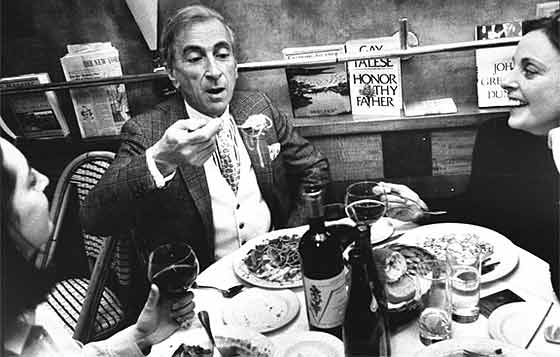
Gay Talese at his table at Elaines?

 
Posted by Picasa


NEW YORK — Everyone went to Elaine's – and now they'll have nowhere to go.

For regulars still mourning the death of Elaine Kaufman in December, the news that her namesake restaurant in Manhattan was closing on Thursday has been a double blow. They gathered one last time at the place where they ate so-so food while rubbing shoulders with the likes of Michael Caine and Woody Allen. And then they will be cast adrift.

"Half the people in this room are never going to see one another again," said legendary writer Gay Talese, who added that Elaine's had created a circle of people, many of whom had nothing in common besides the place itself.

"This is saying goodbye to one another," Talese said.

"I don't know what many of us will do," said TV broadcaster Rikki Klieman, who was introduced to Elaine's by her husband, Bill Bratton, a former New York City police commissioner and Los Angeles police chief. "I guess we'll just have to stay home."

Bratton held court in the packed room at "Jack Maple's table." Maple was the architect of CompStat, the system the New York Police Department uses to track crime. He sketched it out on a napkin at the table in 1994, Bratton said.

"You're going to hear the term bittersweet a lot tonight," Bratton said. "There will be plenty of stories told at these tables tonight and few more made."

Elaine's was synonymous with plugged-in New York for the better part of five decades. "And they were all impressed with your Halston dress and the people that you knew at Elaine's," Billy Joel sang. The restaurant inspired books titled "Everyone Comes to Elaine's" and "Last Call at Elaine's."

For the regulars, Elaine's was more than a scene. It was a family, a club without dues, a dinner party with a glittering guest list.

Ruth Westheimer, better known as sexpert Dr. Ruth, described the night as sitting shiva for the bar. Shiva is a Jewish bereavement custom.

"She went out of her way for people she liked," Westheimer said of Elaine.

Loren Korevec played the piano at the bar from 1987 to 1999.

"It's a kind of mourning – this is never going to happen again anywhere," he said as he greeted old friends including former longtime bartender Tommy Carney, 71, who had just arrived from New Jersey.

"It was so comfortable for us because we were on the inside," said Kathryn Altman, who started going to Elaine's in the 1970s when her late husband, film director Robert Altman, was riding high after "MASH." "It was like a club."

The club was not limited to boldface names. Dana Carey, who is director of event sponsorships for a trade publication, started going to Elaine's as a young woman nearly 30 years ago.

"I knew that every Thursday I could walk in as a single person and I would know about a third to half the restaurant," Carey said. "And everybody was always, `Come sit with us, come sit with us.' There was no other place like it, where you would see an actor, a writer, a neurosurgeon and a former Mets baseball star, all sitting together, and the only common denominator was that they were an Elaine's regular."

Kaufman died at 81 after running Elaine's for 48 years. Longtime manager Diane Becker inherited the restaurant and tried to keep it open before announcing May 17 that it would close for good on Thursday.

"This is one of the most difficult decisions I've ever had to make," Becker said in a statement. "But the truth is, There is no Elaine's without Elaine."

The regulars said Kaufman's uncanny ability to introduce guests to the fellow guest they would most want to meet made it difficult to imagine the restaurant without her.

"If you were sitting alone, she would introduce you to somebody interesting," said Harry Benson, a Scotland-born photographer who arrived in America with the Beatles in 1964 and is currently shooting for Vanity Fair. "A detective who was working on the Son of Sam case. She never put you with some dreary person."

The food was not the selling point.

Allen, who shot the first scene of "Manhattan" at Elaine's, said through a spokeswoman that he was not available for an interview. But he told New York magazine at a screening of his latest movie "Midnight in Paris" that he went to Elaine's every night for decades "despite the unrelenting bad food." He added that "everybody went for conversation and meeting people and chatting, and that was the success of the place."

The decor was indifferent as well. The dark-paneled walls at Elaine's were festooned with the framed covers of books by authors who ate and drank there.

Celebrities like Allen knew that Elaine's was one place where no one would bother them. And there were plenty of celebrities.

"Catherine Deneuve used to go there when she was in town," Benson said. "Willie Nelson. Clint Eastwood. A lot of unlikely people."

Carey said she met her best friend, mystery writer Carol Higgins Clark, at Elaine's. She also met mystery writer Stuart Woods, whose protagonist is always having dinner at Elaine's.

Ruda Dauphin, the U.S. representative of France's Deauville American Film Festival, said she brought people by to show them off to Kaufman and to show Kaufman off to them.

"I brought in Buzz Aldrin," she said. "From the moon to Elaine's. He loved it."

Klieman said that Kaufman would tell her, "I think you might want to stay tonight" when she was expecting a Jack Nicholson or a James Gandolfini.

Her husband, Bratton, said the clientele spanned the range of New York life from writers and actors to the occasional mobster.

"The cast of characters could best be described as sort of a Damon Runyon crew," he said.

Many of the regulars have been returning to Elaine's every night since the closing was announced and planned to be there Thursday.

"Everybody changed their plans in order to be there," Klieman said.

They will exchange numbers and make plans to keep in touch, but it won't be the same.

"Everybody will eventually find a new place to go but we won't all find a new place together," Carey said. "We'll all gravitate to different places."

There may be speeches. There will surely be tears.

"It's like losing Elaine twice: first herself, then the living room where she conducted her nightly salon," Woods, the mystery writer, said in an email. "It was a club where the public were allowed to pay to watch the members dine, and the members liked that."

___

Talese House Ocean City

 
Posted by Picasa


Gay Talese, Famed Ocean City Writer, Has Packed Up and Left the Island
By Kevin C. Shelly

His wife's purchase of a country home led to his decision to sell the century-old Ocean City house they’d owned since 1967, when they bought it for $37,000. It sold for $1.6 million.

http://oceancity.patch.com/articles/gay-talese-famed-ocean-city-writer-has-packed-up-and-left-the-island?ncid=M255

Gay Talese reluctantly but resignedly left the island that spawned him Friday.

Accompanying moving trucks, the famed 79-year-old writer and his wife, noted publisher Nan A. Talese, 77, are headed to a country home in Connecticut -- a home she bought without his knowledge.

After the purchase, she waited a month to tell him.

As he said of his wife earlier in the week, “she has her will,” reminding me that Nan had forced the issue of marriage on him at the start of their long relationship.

His eldest daughter, painter Pamela Talese, laughed when I mentioned her father’s comment to her Friday.

“There is no movement, no accommodation from Gay Talese. He hasn’t changed direction for as long as I’ve known him,” said Pamela, who spent summers in Ocean City. Her mother had wanted to move for years, she said, and the buy forced the issue.

Pamela says each summer she was watched over by a nanny while her father worked a set schedule writing in a sequestered third floor office in the Ocean City home and her mother worked during the week in New York publishing houses, coming to Ocean City for weekends.

Unable to justify maintaining three homes -- the couple has lived in a brownstone on the Upper East Side since they married more than 50 years ago -- Talese struggled for months to come to terms with his wife’s decision.

Nan's purchase of a country home set in motion his decision to sell the century-old Ocean City house they’d owned since 1967, when they bought it for $37,000.

Eventually, he listed his Ocean City home for sale, but wanted no sign, no open house, no special marketing effort. Even with his home for sale, he was not quite ready to cut ties to the city that shaped him as a journalist and safe-harbored him as a writer.

I’ve know Gay for 29 years, but I learned of the sale second-hand. So I wrote him
-- the surest way of engaging him, though he has begun using email.

Several notes came to me last winter, including a trademark post card he’d fashioned from a shirt cardboard. The letters discussed his emotional struggle with going through with the sale. He didn’t want to have a story written about the possible sale until the home sold because he simply was not ready.

On April 13, I called Gay and informed him that the buyers he’d selected -- he chose the buyer’s he’d verbally committed to first, not the highest offer -- had agreed to buy the house.

The couple buying the home, with a long family history in Ocean City, paid $1.6 million, $200,000 under the asking price. They plan to rehabilitate the home and move into it, a process they think could take a year and hundreds of thousands of dollars.

A closing is set for June 10, though the agreement could come sooner, according to the buyers, who have asked not to be identified until the sale is complete.

Gay was still clearly conflicted by the sale when I spoke to him at the E. Atlantic Boulevard residence Thursday amid packing and preparing to have dinner with the buyers.
He talked of how crowded Ocean City is now, how bad the parking has become, the wear on his wife caused by traveling to and from Manhattan on the jammed Garden State Parkway and the mess caused by reconstruction on the Route 52 causeway.

But he also spoke of how his career as a writer of books -- he’d begun as a journalist, writing about sports and features, first for the Ocean City Sentinel Ledger and The Press of Atlantic City before college, eventually taking a job at the New York Times -- had taken shape here.

He also spoke of the pleasure he’d gotten from spending summers at the shore with daughters Pamela and Catherine, and spending time with his late mother, Catherine Talese. His mother's home was a few minutes away, also in the Gardens section of the city.

We also talked of the the book he is at work on: his relationship with his wife.
Nan, who usually absents herself when Gay is interviewed, mixed in more than usual Thursday. She rolled her eyes and smiled when I asked about the topic of the planned book.

“I married a writer, and I trust his writing. But he knows nothing about marriage. I’ll be surprised when I read it,” she said.

As we spoke, neighbors stopped by to ask if it was true that the house was sold, to recall old times, to ask about the Talese’s grown daughters.

As the talk wound down, Gay handed me a signed copy of Unto the Sons, a book set largely in Ocean City.

He gave me the book, in part, because he was working on the galley proofs for the book when I first met him.

But he also gave it to me because it was one fewer thing that he needed to worry about taking with him -- or leaving behind.

A full account of my interview with Gay Talese will appear in the July edition of New Jersey Monthly.

For more information on Talese: randomhouse.com/kvpa/talese/

Gay and Nan Talese in Ocean City

 
Posted by Picasa


Where a Literary Couple Catch their breath Down the Shore
Julia Lawler - NYTimes Travel Section - August 3, 2007

http://travel.nytimes.com/2007/08/03/travel/escapes/03away.html


See: Slide Show
Ocean City

http://www.nytimes.com/slideshow/2007/08/03/travel/20070803_AWAY_SLIDESHOW_index-10.html

GAY TALESE never learned to swim and only occasionally ventures onto the beach. The wind makes it impossible for him to read the newspaper and, he said, during a recent visit to his second home in Ocean City, N.J., “I’m not going to sit on the sand swatting flies.”

Yet for the last 40 years, Mr. Talese, a writer, and his wife, Nan, a Manhattan book editor, have spent weekends and summers there, in the town where he was born, tucked into a rambling red-shingled Victorian they own that sits just one block from the ocean.

Unlike the Hamptons or Litchfield, Conn., where many of the couple’s Manhattan friends seek refuge, Ocean City has long been a getaway for middle-class Philadelphians.

The Taleses like it because it’s the antithesis of the Manhattan literary whirl. So, don’t ask for a whole-wheat roll at the hoagie shop, or a chic mixed drink when you’re dining out. Ocean City has been dry since its beginnings as a Methodist retreat in 1879. Night life? Choose between the kiddie rides on the boardwalk or star-gazing on the beach.

“It’s a great contrast to New York,” said Mr. Talese, who is 75, as he conducted a tour around town, pointing out the building on Asbury Avenue where his mother owned a dress shop, his father ran a tailoring business and the family lived in an upstairs apartment.

Large parts of many of his books, including “The Kingdom and the Power”; “Thy Neighbor’s Wife”; “Unto the Sons,” a family reminiscence that’s largely set in Ocean City; and his latest, “A Writer’s Life,” were written in the third-floor office of his Ocean City Victorian.

“Nobody bothers me here,” he said. “I much prefer it in winter. It’s empty, and you can see the sky. It’s light, and cheerful.”

Built in 1902, the house sits on a tree-lined street in one of the resort town’s most desirable neighborhoods, the Gardens. As in most houses of its kind at the shore, the first floor is raised above street level to take advantage of sea breezes, with a wraparound porch, white wicker furniture and a green-and-white-striped awning. Although the original view from the front porch favored dunes stretching all the way to the Atlantic, by the time the Taleses arrived there were already houses across the street. Five years ago, those were torn down and replaced by town houses, which still did nothing to revive the old sea view.

If you squint, though, you can still see a bit of ocean from a wide window seat in the second-floor master bedroom. Mrs. Talese, who is publisher of Nan A. Talese/Doubleday books (her writers include Margaret Atwood and Ian McEwan), likes to read there in the afternoons after her morning swim and some weeding in the garden. “It’s marvelous with the sun on your skin,” she said.

The house has seven bedrooms, four on the second floor and three on the third, one of which is Mr. Talese’s office. The three bathrooms on the second and third floors contain original claw-foot tubs, each painted to coordinate with the wall color.

Their purchase of the house came about almost by accident. The couple rented it for the summer in 1967 when their older daughter, Pamela, was a toddler, and their younger daughter, Catherine, was a newborn. They were planning to rent it again the next summer when they discovered that another family was considering buying it to live in year-round.

“I said to Gay, ‘Buy it,’ ” Mrs. Talese recalled. They were renting an apartment in an Upper East Side brownstone, a building they would buy many years later, and had little money to spare. But it didn’t deter her. “It was on the spur of the moment,” she said. “He’s cautious. He wants to be unfettered. But I like real estate.”

It turned out to be a wise investment. The house cost $32,000, including the adjoining lot. Mr. Talese said he recently had offers of $1 million to $1.4 million.

Although the two considered buying a place in the Hamptons or Connecticut in the 1970s to be able to spend more time with friends, they decided it would be too much like their social life in New York.

“It’s a place to be away,” Mrs. Talese said. “When we come down, we just stay at home.”

One of the first major changes they made was to winterize the house so Mr. Talese could write there year-round. A deck was added on the back, and bookshelves were added to in the dining and living rooms. And a pantry wall in the kitchen was demolished to open up the space.

Mr. Talese’s third-floor office is set up so that he rarely has to leave. There is a bed that he sleeps in when he’s in Ocean City alone; an ancient IBM Selectric with a grimy plastic cover; and a five-year-old Power Macintosh, which is not connected to the Internet. (Mr. Talese does not engage in e-mail and prefers to hand-deliver his manuscripts to his editors). To reduce the glare from a skylight, Mr. Talese has put together a plastic foam canopy that swoops over his U-shaped desk like a sail on a blustery day. Mrs. Talese calls it “the suspension bridge.”
Multimedia

Slide Show
Ocean City
His summer routine is to write in the morning, play tennis in the afternoon, then maybe watch a game on the 36-inch Sony Trinitron with DirecTV service that he has set up in his office. His tastes run from the Yankees to Japanese skiing.

At the other end of the hall is a room that doubles as a home gym (Mr. Talese lifts weights, and Mrs. Talese uses a videotape for Pilates) and a guest room for visiting writers. The novelist William Kennedy and Mr. Talese’s cousin, Nick Pileggi, are among those who have stayed and worked there for extended periods.

The house is strictly a kick-off-your-shoes-and-stay-awhile place, even though Mr. Talese continues his habit of dressing formally — even in the heat of summer.

“There’s nothing spiffy about this place,” Mr. Talese said one 90-degree day earlier this summer, looking natty in a long-sleeve, pink linen shirt with contrasting white collar, cufflinks, tan pants, a yellow-and-green neck scarf, white belt and brown shoes. Outdoors, he covered his silver hair with a straw fedora and, by early evening when the sun had lost its edge, slipped on a beige jacket with a yellow silk handkerchief tucked in the pocket.

Memories are what seem to count most in the Taleses’ Ocean City home. In the living room, the surface of an old baby grand piano with yellowing keys that once belonged to Mr. Talese’s parents is crowded with family photos and pictures of him with his writing peers — John Irving, Kurt Vonnegut, William Styron, Norman Mailer, Joseph Heller. In one baby photo, the Taleses’ daughter Catherine, now a photo editor in New York, sits on the lap of the legendary Random House editor Bennett Cerf.

Journalist pals, like the late David Halberstam, have always been frequent guests. Pamela Talese remembers her father and his writing cronies lined up on the front porch in their chairs in the mornings, each with his own copy of The New York Times.

Growing up, the Talese children remember old-fashioned summers of swimming, biking and baseball games in the yard. But they also had chores. Each morning they would buy their father a glazed doughnut, leave it outside his office door, then return at 11 a.m. with a plate of poached eggs. After reserving a tennis court for her father in the afternoon, Pamela would bring him a hoagie sandwich and half a beer at 3 p.m. while he watched a ballgame on TV. “Then he would go back and write,” she said.

Although the Talese children have long been on their own, they say they still love visiting the Ocean City house. Once there, they fall into the old routine — padding around in bare feet and taking daily dips in the ocean with their mother, who’s an avid swimmer. On a rare day, they might even catch a glimpse of their father on the beach in a long-sleeve shirt, straw hat, neck scarf and swim trunks, struggling with a newspaper and swatting flies.